Screening & Flow Conditioning
Incoming wastewater is screened and stabilised before biological treatment. This protects downstream equipment and helps maintain more consistent hydraulic conditions.
 GET A QUOTE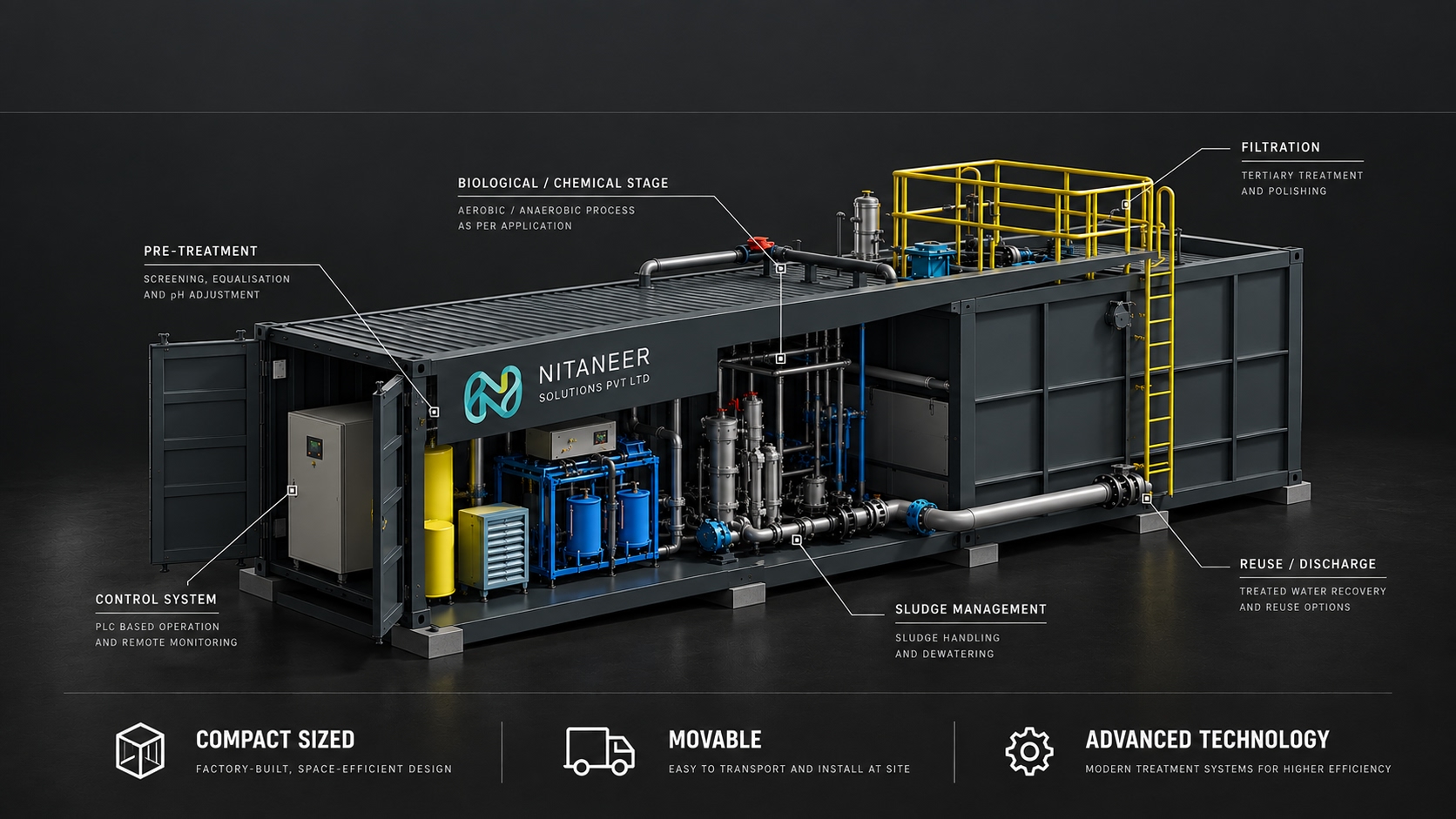
Nitaneer is developing compact, modular water-treatment systems that reduce unnecessary plant footprint while keeping the treatment process practical, maintainable and adaptable to real operating conditions.
Conventional treatment plants can become large, fragmented and infrastructure-heavy. Nitaneer starts from a different question: how much treatment can we achieve in a smaller, better organised system?
Our approach brings biological treatment, solids management, polishing and disinfection into a compact process architecture that can be configured around the wastewater, required capacity, reuse objective and site.
The objective is not simply to make equipment smaller. It is to remove unnecessary complexity while preserving the treatment stages that matter.
The exact engineering changes from project to project, but the platform follows a clear treatment logic from influent conditioning to final treated water.
Incoming wastewater is screened and stabilised before biological treatment. This protects downstream equipment and helps maintain more consistent hydraulic conditions.
The biological stage reduces organic pollution by creating an environment where treatment microorganisms can work efficiently within a compact reactor volume.
High active-biomass retention allows the biological system to achieve meaningful treatment performance without relying on oversized conventional process tanks.
Suspended solids and biological material are separated from the treated water through a dedicated clarification or separation stage.
Treated water passes through additional polishing stages selected according to reuse requirements, influent quality and project conditions.
The final water stream is disinfected before discharge or reuse, with the exact configuration determined by the intended application.
Biological treatment works by maintaining microorganisms that consume and transform pollutants present in wastewater. A more compact system depends on retaining sufficient active biomass and providing the conditions needed for stable treatment.
Nitaneer's platform is being developed around this principle, combining compact biological treatment with downstream solids separation, polishing and disinfection.
The treatment train is designed around space efficiency, reducing dependence on large conventional civil-treatment layouts where project conditions allow.
Core treatment stages are organised as modular systems so capacity, polishing and ancillary equipment can be configured around the actual project.
We prioritise a clear process train and practical operating logic instead of adding unnecessary equipment simply to make the plant appear more sophisticated.
Maintenance access, component availability, operator usability and field conditions are considered alongside process performance.
The comparison describes the design direction of the Nitaneer platform. Final plant performance and configuration depend on wastewater characteristics, capacity and project requirements.
Larger civil-treatment area
Compact modular treatment layout
More site construction
Higher degree of modular assembly
Capacity changes may require major civil work
Designed around configurable treatment modules
Equipment can be distributed across large plant areas
Service access considered within the module layout
Depends heavily on site-specific implementation
Instrumentation can be integrated around the process train
Often engineered as a one-off civil plant
Platform approach adapted to project conditions
The treatment process is supported by pumps, aeration equipment, piping, instrumentation, recirculation, solids handling and control components selected around the application.
Wherever practical, components are organised into an accessible, modular equipment layout so the system remains easier to install, inspect and maintain.